

You’ve probably seen the news: protests are breaking out across Europe, and a lot of them are about housing. Spain, France, Albania, and now Portugal. The details change from country to country, but the complaint is related to rising cost of living. In some countries (such as Portugal), housing has become unaffordable, especially for young people.
Here in Portugal, protesters have been camping in Lisbon’s Rossio and Porto’s Praça D. João I, the main squares of both cities, putting the protests right at their heart. The police cleared both camps and arrested people, and the organisers have already called the next protest, with no signs of slowing down.
Of course, this powder keg is a gift to both the far right and the far left. Both extremes have flooded their social media channels (the far right, arguably, more loudly) with the same trick: there is one villain, one cause, one explanation for rising prices and the cost of living. Of course, both are wrong. With their natural stupidity, they get most of the things wrong, with their painfully simple-minded view, grabbing at whichever scapegoat fits their worldview and ignoring everything else. They occasionally stumble onto a correct detail, the way a stopped clock is right twice a day, but they never get the full picture.
Side note: After this paragraph, now people will call me the extreme (or enlightened, if they are reddit users) centrist. Oh no, the horror.
Anyway. in this post I want to walk you through the data behind all this, so you can see what’s happening and why. I’ll debunk some myths along the way.
The data I’m presenting here comes from:
INE (Statistics Portugal): house-price index, median prices per m², sales by where the buyer pays tax, rents, population, and building licences and completions
Banco de Portugal (BPstat): mortgage stock and rates, household disposable income
Eurostat: EU house prices, rents, housing-cost overburden, building permits, population
European Central Bank: Euribor and mortgage rates by country
OECD: price-to-income and price-to-rent ratios
World Bank and Our World in Data: long-run population, urbanisation and migration
Eurostat GISCO and DGT (CAOP): map boundaries for regions and municipalities
Context
On Saturday night there were more than a hundred tents in Rossio. In the early hours of Tuesday the police cleared them, and 55 people were detained. Five days earlier the same thing happened in Porto, at Praça D. João I, where the organisers say 39 people were hurt. The organisers have already called the next protest.
These protests aren’t new. They are the latest chapter of a long struggle by Portugal’s young people, and the photo below was taken back in 2023.


When the first images from Porto came in, what I felt was empathy. I was lucky enough to buy a house 5 years ago at 29. Thousands of young people in this country haven’t had that luck, and a lot of them can’t afford to leave their parents’ home, let alone build a life here. I wish young people in Portugal had the same chance I had to build a family and a future.
Even if you set empathy aside, this is a very bad sign for the country’s future. The young people with the best options are the ones most likely to leave, and once again we’ll watch our best talent build their careers somewhere else, similar to what happened between 2009 and 2012.
Myth 1: “The youth just needs to work harder” - False
We’ll start with the easiest to debunk. This is just a very ignorant take.
The headline number is that prices have more than tripled since the bottom in 2013. INE’s house price index went from 92 in mid-2013 to 301 in the second quarter of 2026 (2015 = 100). Prices are still growing 16.5% a year. The EU average is 4.7%.
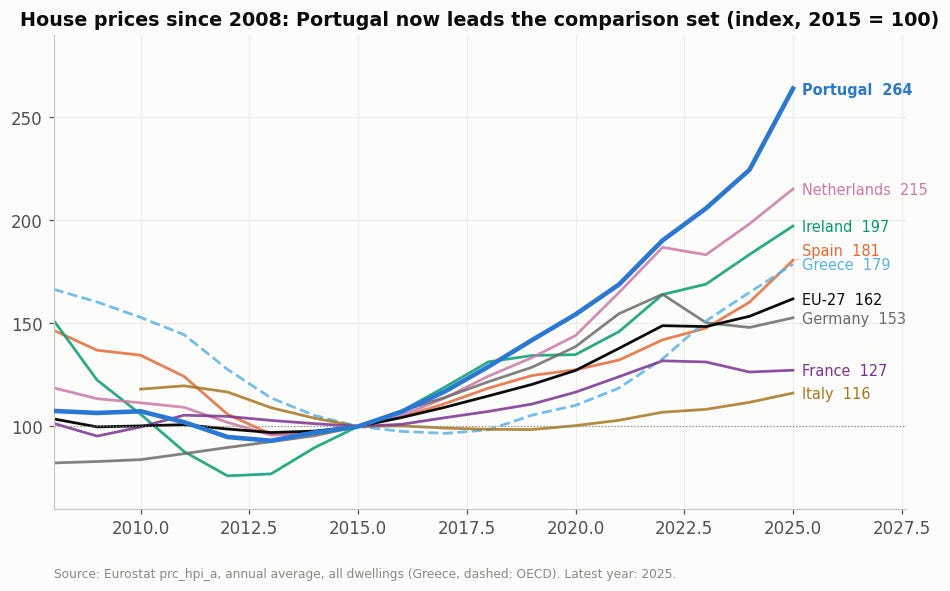
Between 2015 and 2025, only one country in the EU/EEA saw prices rise faster than ours. We went from being a cheap place to buy a home to leading the European pack, above the Netherlands, Ireland and Spain, which are the countries we used to look at with pity when their bubbles popped. No country in western Europe reaches Portugal levels:
A rising price on its own isn’t a crisis. If my salary triples together with the price of the flat, we should be fine. Of course, that didn’t happen:
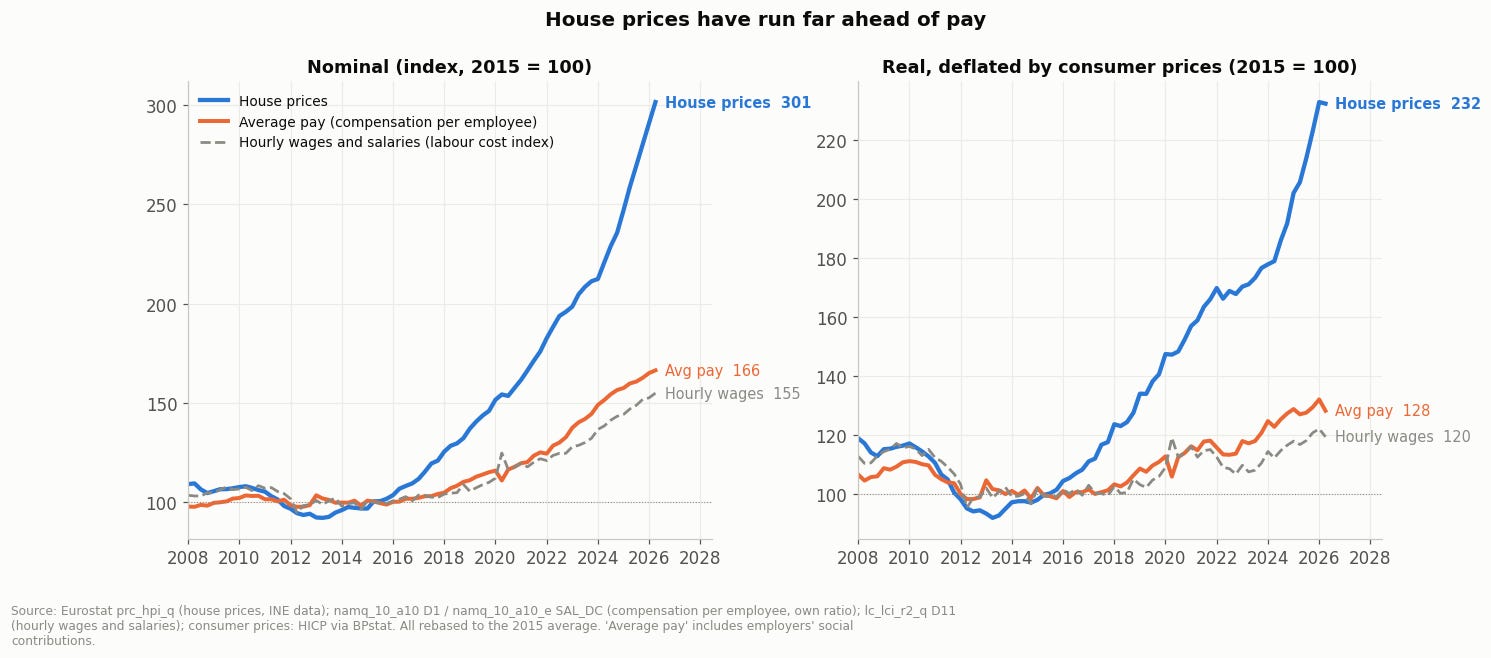
Salaries did go up in the last few years, but nowhere near as fast as house prices. Once you account for inflation, pay is up 28% since 2015 and house prices are up 132%.
Since 2015, house prices are up 201%. Average pay is up 66%. Strip out inflation and it’s +132% against +28%. In the last twelve months alone, prices grew 16.5% and pay grew 4.1%.
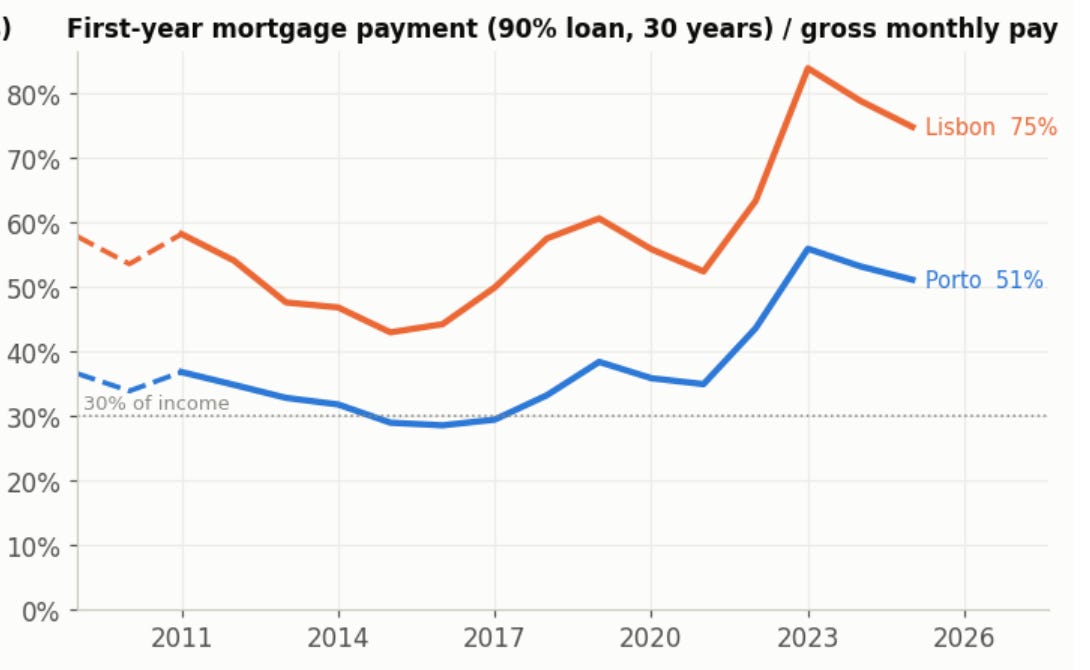
“Young people don’t want to work anymore” is not a good take, at all. Take a young Portuguese graduate earning 30% above the minimum wage, which is a fairly typical first salary. In 2025, a standard mortgage on a home in Lisbon would swallow about 75% of their gross pay, and 51% in Porto, against a usual affordability threshold of 30%. Fifteen years ago the picture in Lisbon was already bad, at about 58%, but around 2015 it dipped to the low forties, and in Porto a first home briefly cost less than a third of a young salary. That door has closed.
And these are gross figures: after taxes, the mortgage would eat most of what actually goes to the bank account, assuming the bank would even approve the loan, which under current lending rules it almost certainly wouldn’t. When effort no longer buys the things it used to buy (a home, some stability, a sense of building something), it’s not surprising that some people stop believing in the deal.
If young people do not buy, they can rent, right?
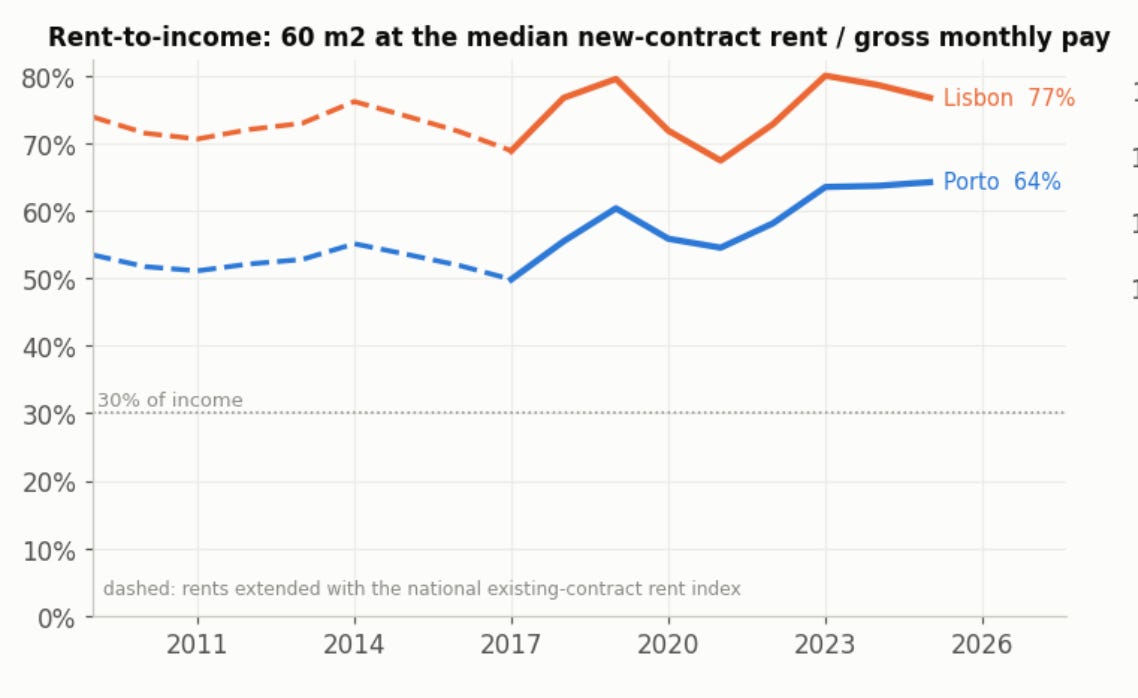
Right.
So yeah, the youth is a bit screwed.
Myth 2: “Immigration hasn’t contributed” - False
We are facing a problem of musical chairs. The cleanest way I found to explain what’s happening is that we are playing a game where we keep adding players and nobody is bringing in chairs.
For most of the 2010s Portugal’s population was shrinking. After the crisis of 2010-2012, population kept falling. Then, from 2021, the population jumped:
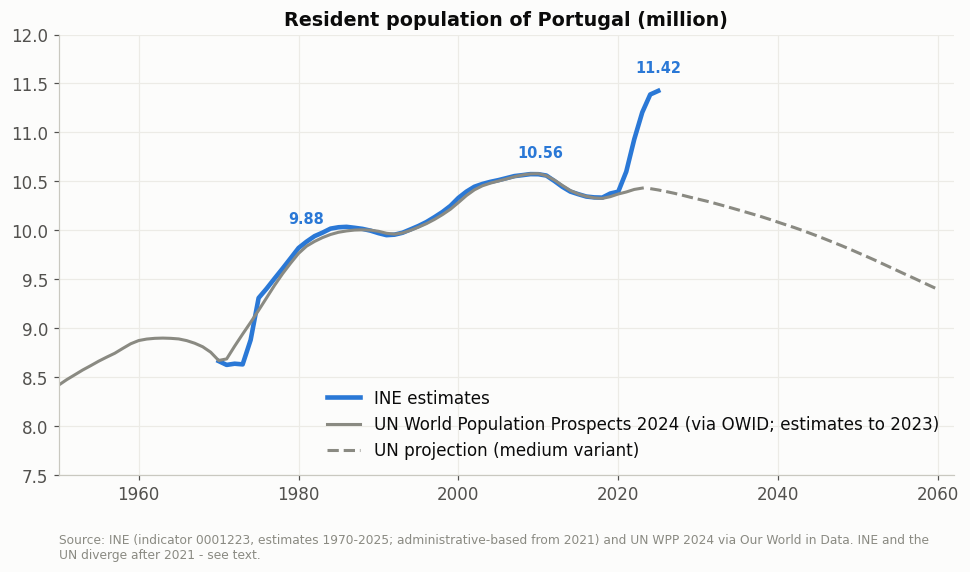
INE counts 11.42 million residents at the end of 2025, 1.05 million more than in 2019 (+10%). Most of it is coming from migration. Natural change (births minus deaths) is negative. There are now 1.6 million foreign nationals living in the country, 14% of residents, and the number of Portuguese nationals fell by about 181,000 since 2015.
(One caveat. INE’s estimate is about a million people above the UN’s for the same year, because INE switched to counting people in administrative records in 2021. So even “how many of us are there” is uncertain. But every source agrees on the direction.)
But people didn’t spread out evenly. Lisbon, Porto and the Algarve hold half the country and that percentage has been growing. Between 2011 and 2023 the Lisbon area grew 15%, the Algarve grew 26%, and the rest of the country grew 0.6%. Predominantly rural areas lost almost a tenth of their people.
The pressure is piling up on the big urban areas, from immigrants and from Portuguese people moving in from the rest of the country. Lisbon, Porto and the Algarve are growing much faster than everywhere else:
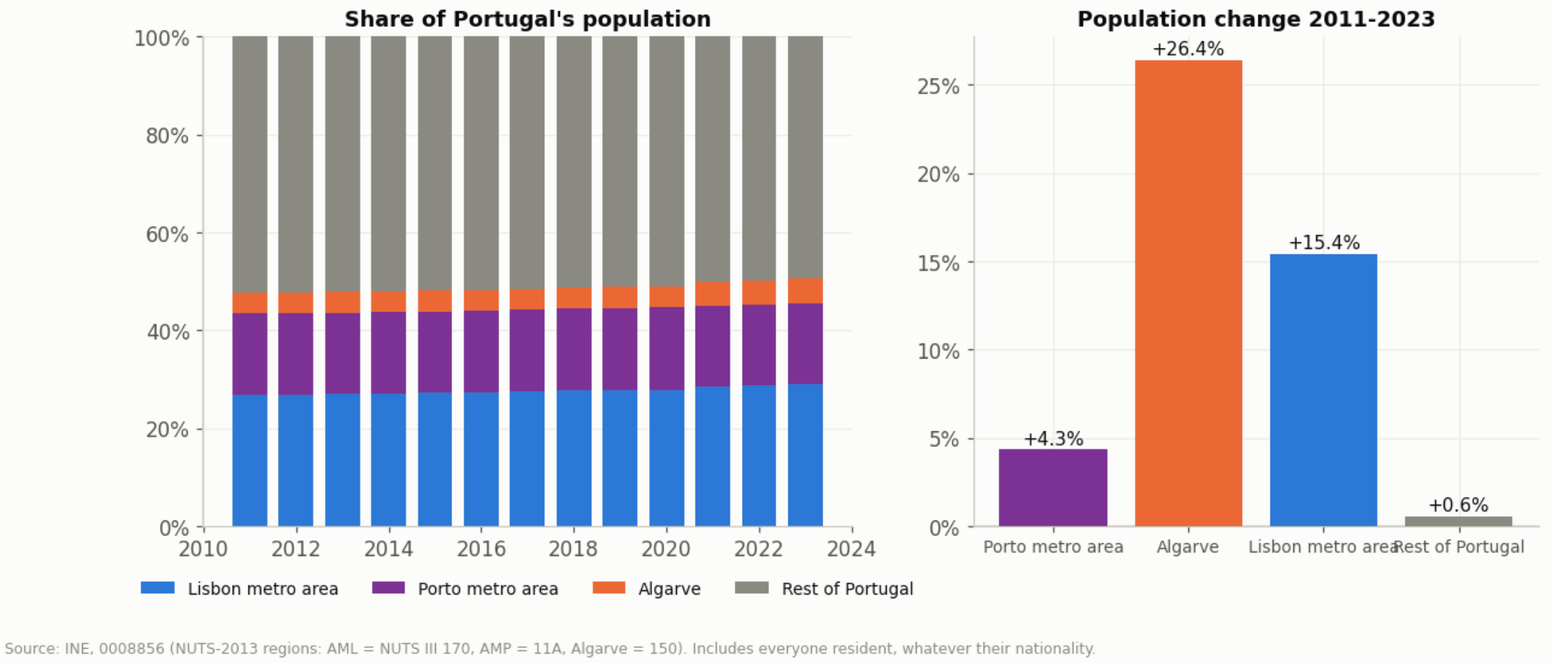
This is factual. We have more people in the country, period. That contributes to the problem but before you jump to conclusions, it’s just one ingredient contributing to the cause. For example, look at the rest of Europe share of immigrants:
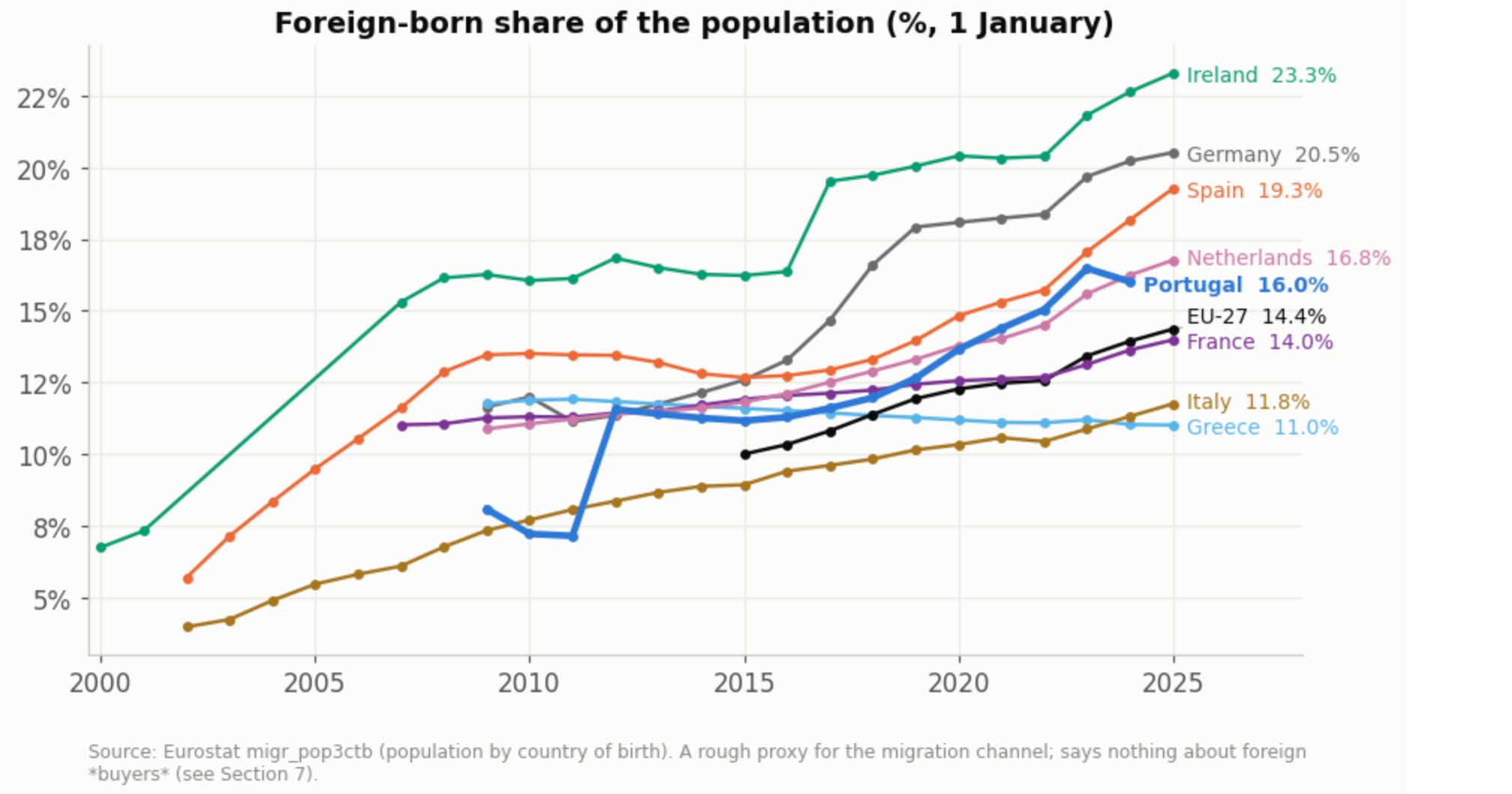
Immigration is rising across Europe, not just in Portugal, yet prices haven’t gone through the roof everywhere the way they have here. So they must do something differently (and they do.)
Whatever the far right claims, immigration is not the single factor that explains it all.
Because…
Myth 3: “We don’t need more construction” - False
We have more “players” in our musical chairs game, but that isn’t inherently bad - it’s actually positive for an economy that desperately needs workers. But in this game, how many more chairs do we have available?
In 2002 Portugal completed about 130,000 new homes. In 2015 it completed fewer than 10,000. Ten thousand, for a country of ten million people. The construction sector died with the sovereign debt crisis and never came back at scale. In 2025 we finished around 30,000.
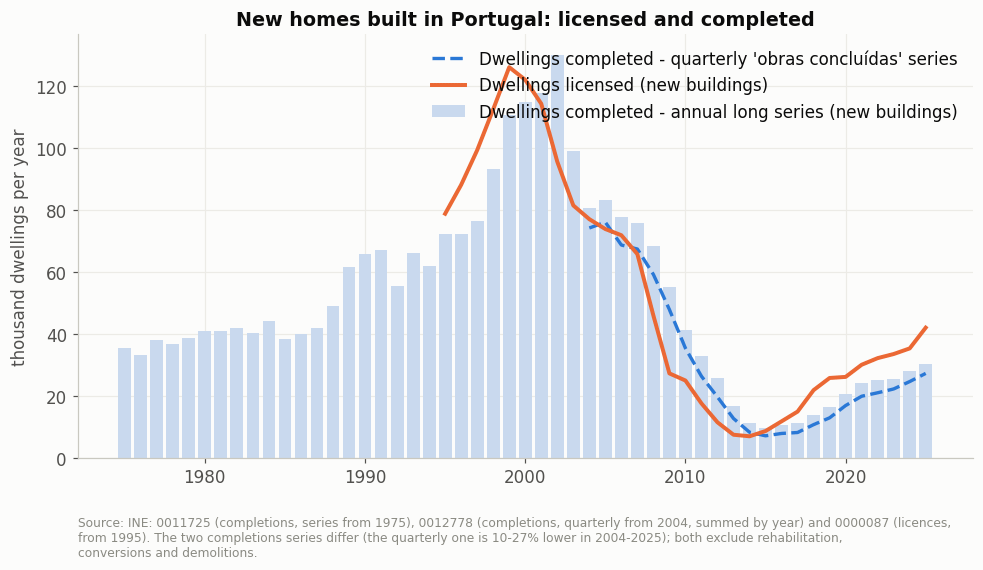
Since 2015 the number of households grew by about 461,000. In the same period we completed somewhere between 172,000 and 207,000 homes (INE has two series that disagree). That leaves a gap of roughly 255,000 to 290,000 homes.
That is the missing 300,000. To close it over 10 to 20 years we would need to finish 61,000 to 76,000 homes a year, every year, which is between 1.3 and 2.8 times what we build today.
Enjoying The Data Journey?
Each of these analyses takes me dozens of hours. If you found it useful, you can buy me a coffee below.

Or you can join a group subscription for one coffee a month:
Seen like this, the house pricing crisis stops being mysterious. A million more people, mostly arriving in three regions, into a housing stock that didn’t grow for a decade. Prices did what supply and demand expected.
Conclusion: Of course we need more construction. And a lot.
Myth 4: “It’s just investors flipping houses” - Needs Verification
This one is very tricky to debunk and probably where I trust the data less. With the available data, it depends a lot on where you look.
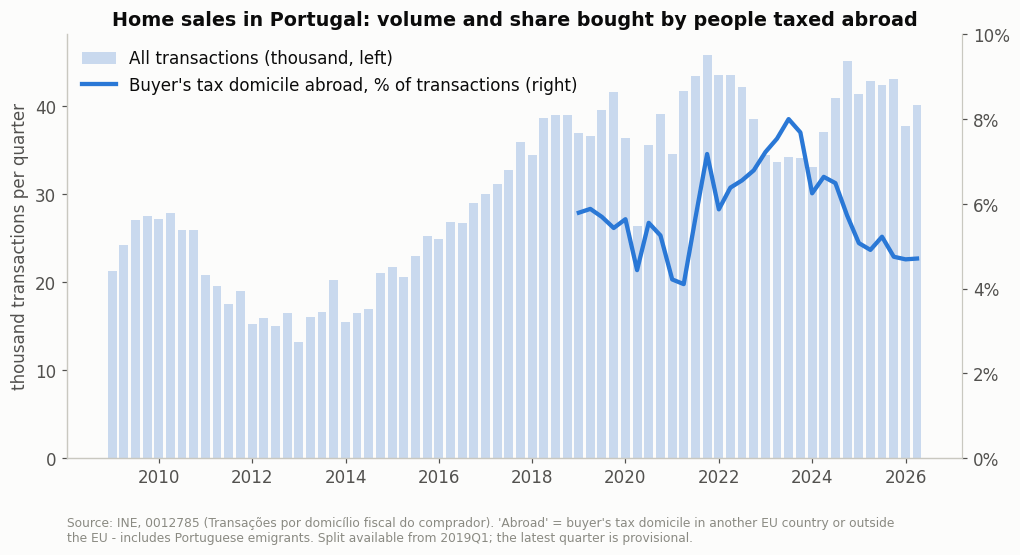
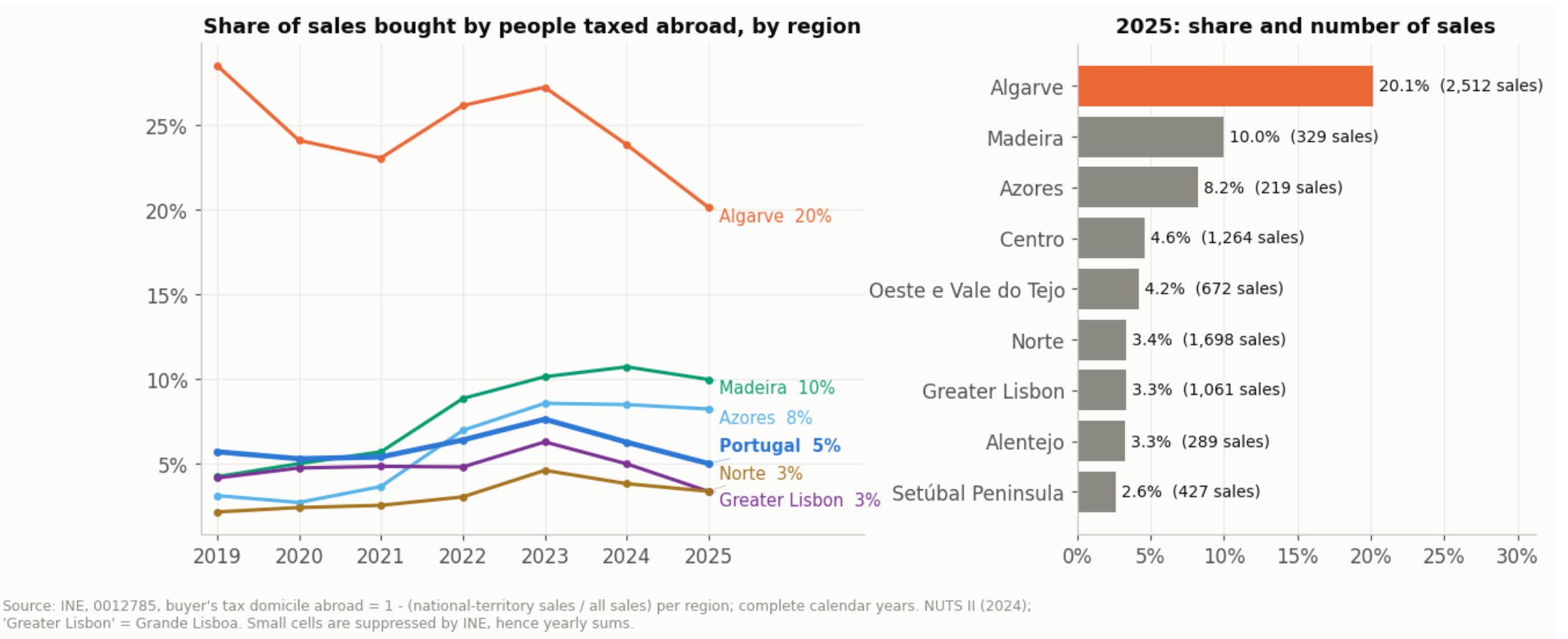
Nationally, in 2025, about one sale in twenty (5.0%) went to buyers whose tax residence is outside Portugal. That share peaked at 7.6% in 2023 and has been falling since. In Greater Lisbon it’s 3.3%. In Madeira, 10%. In the Algarve, one in five.
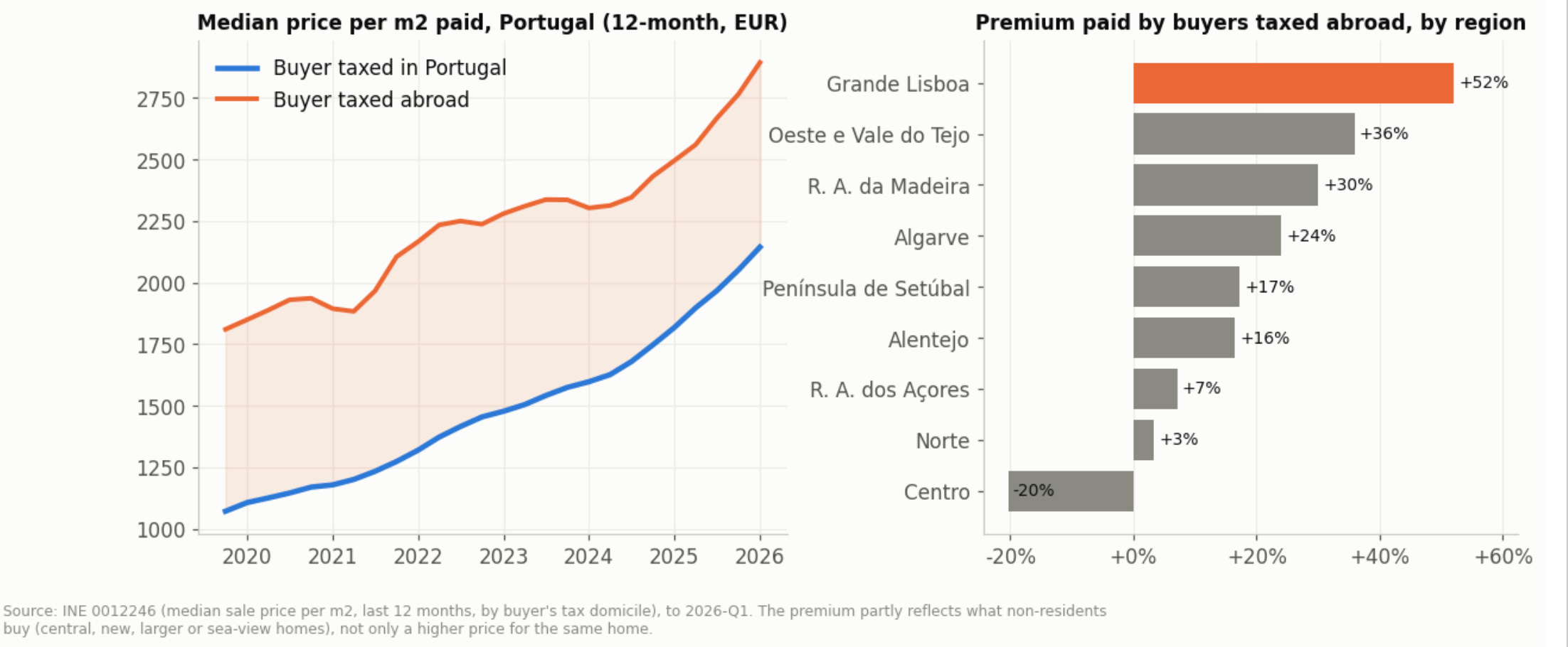
Buyers taxed abroad also pay about 35% more per m² nationally (52% more in Greater Lisbon), partly because they buy a different kind of home. So at the top of the market, and in the Algarve, foreign demand is a real force. It also pushes families out of the center, putting pressure on the suburbs. This type of buyer is always paying premium, which contributes to the mix. For example, a buyer taxed abroad paid more 52% for a house in Lisbon than a local, signalling that they typically buy luxury / more expensive homes.
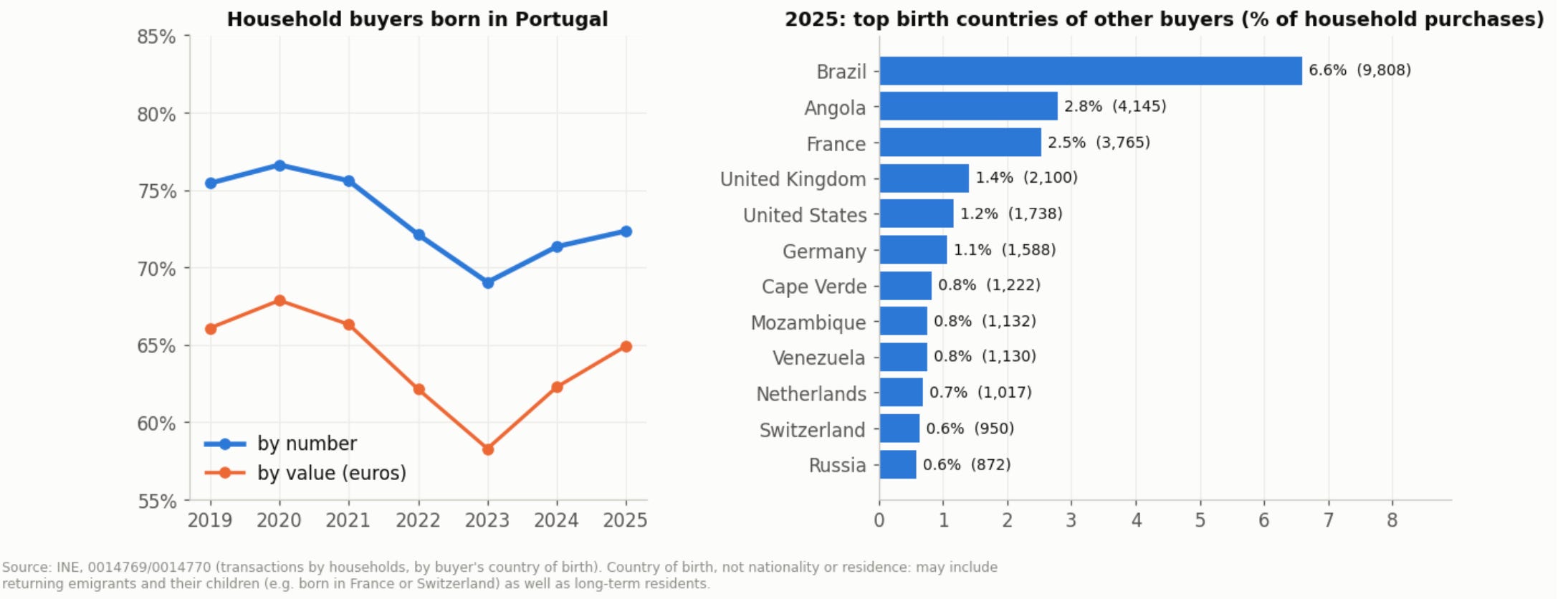
There’s a big asterisk here. Portugal does not publish buyers’ nationality. “Taxed abroad” includes Portuguese emigrants and excludes foreigners who already live and pay tax here. But it published buyers by “country of birth”, which is a proxy. One in every three buyers is foreign:
The NHR tax regime cost €1.74 billion in 2024 alone, with almost 129,000 beneficiaries (IGF audit, as reported by ECO). It closed to new entrants after 2023 (and we see that effect in the charts). The golden visa property route ended in October 2023. But, even with that disappearing it didn’t correlate to a crash in prices, so the “investment vehicle” effect is probably less strong than what people assumed.
One angle where we can see that these players still have an effect on the market, is by looking at the number of Real Estate investment firms in Portugal:
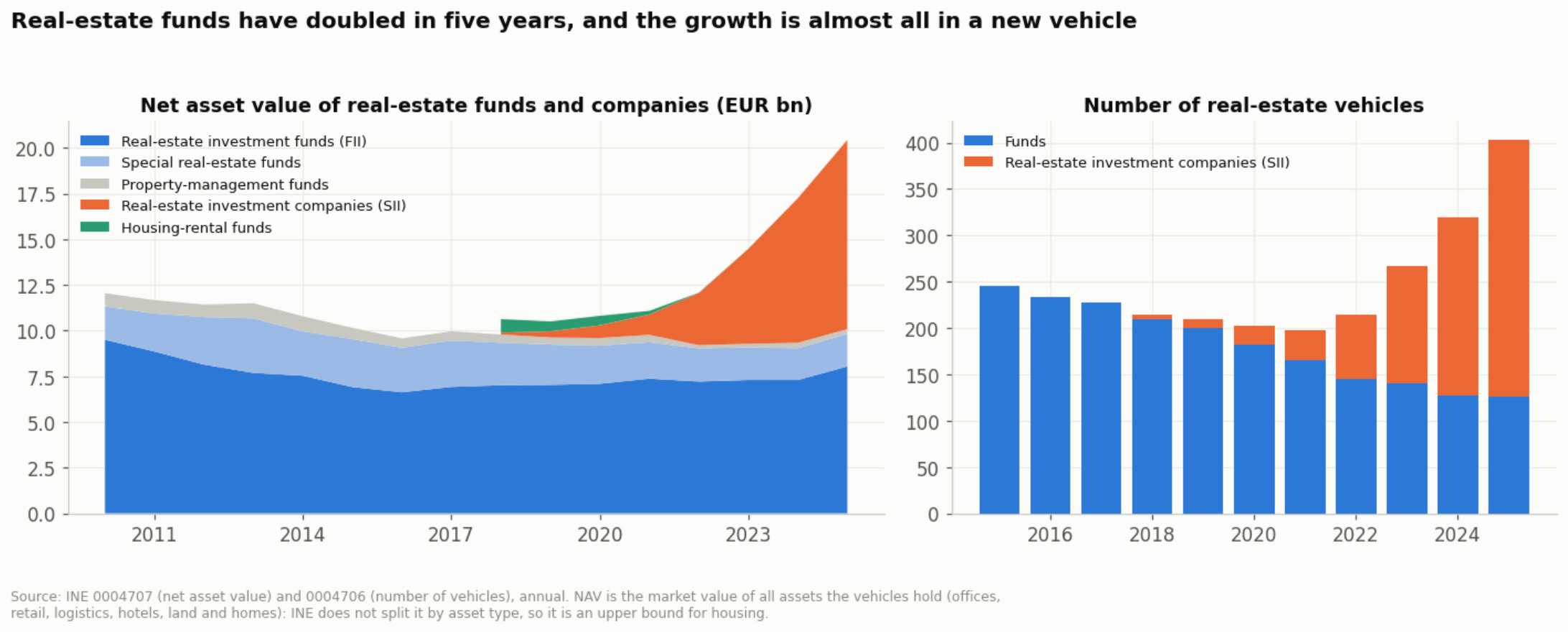
REITs (SII) have grown quickly in Portugal, but it’s hard to say what that growth means. The vehicle only became legal here in 2019, so many of today’s REITs may simply be existing property companies that converted to the new structure rather than new capital entering the market. There is a correlation between their rise and rising housing costs, but without knowing where each of these companies came from, we can’t claim the first caused the second.
Myth 5: “Vacancies are a negligible problem” — False
That’s wrong.
Vacant homes are a big part of the problem. At the 2021 Census, Portugal had 723,215 empty homes, or 12.1% of all housing, and these were mostly in the municipalities with the highest demand, notably Lisbon and Porto. Of those, 348,097 were for sale or rent, while 375,118 were vacant for “other reasons”: the previous occupant had died, the heirs were still waiting to divide the estate, the home was awaiting renovation, or the reason wasn’t specified.
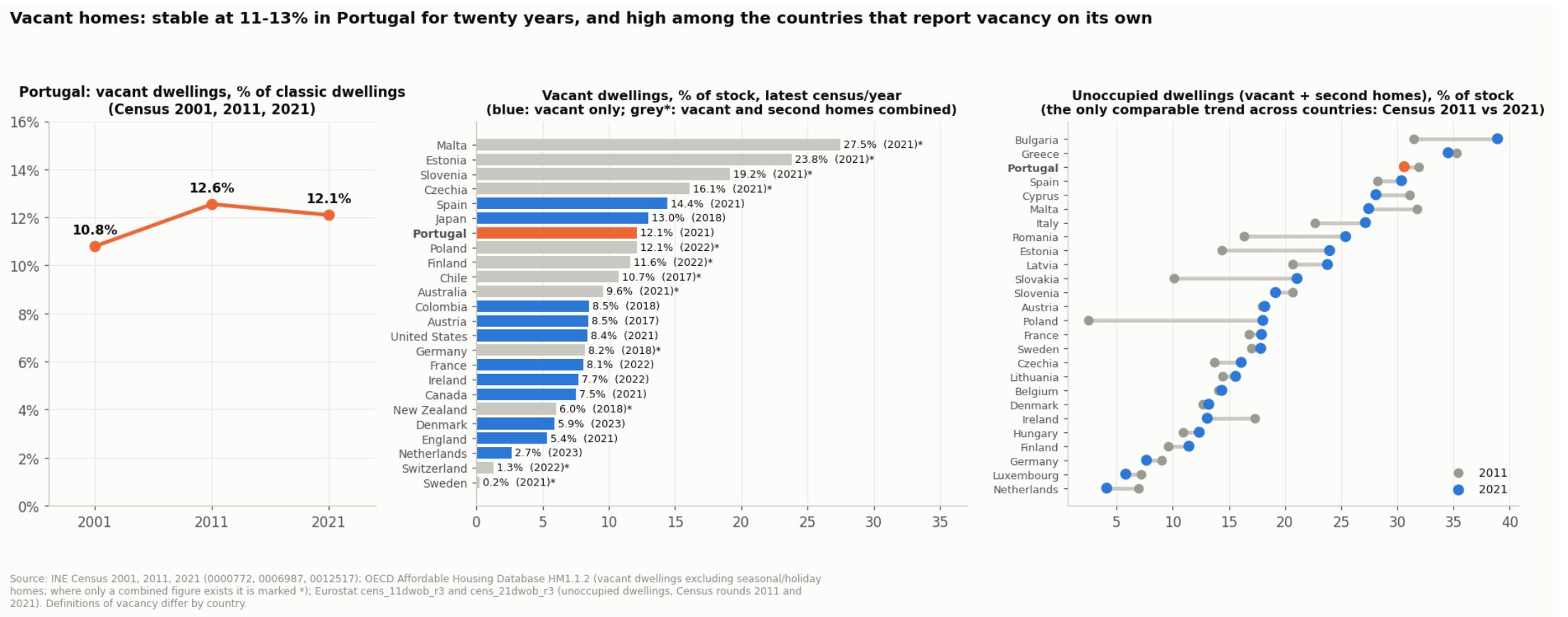
The inheritance problem is structural, and it comes from how succession works in Portugal.
First, the law gives heirs a fixed share: no one can freely dispose of all their assets after death, and spouses and children (or parents, if there are no children) must be treated equally. A house therefore rarely passes to one person who can decide what to do with it. Second, until the estate is divided, every asset belongs to the inheritance as a whole, and the heirs own only shares of the total rather than specific properties. In practice, nothing moves unless everyone agrees. Third, the courts are slow: inventory proceedings take on average 60 to 70 months, and court costs have turned many inheritances into a kind of asset prison, with about 32,000 estate-division disputes pending in courts and notaries. Fourth, the problem compounds over generations: the number of heirs grows as each generation inherits what the previous one never divided. The result can be absurd. In one case in Oeiras, the municipality wanted to buy a house for youth rentals, but it remains empty because one of its 30 heirs won’t agree.
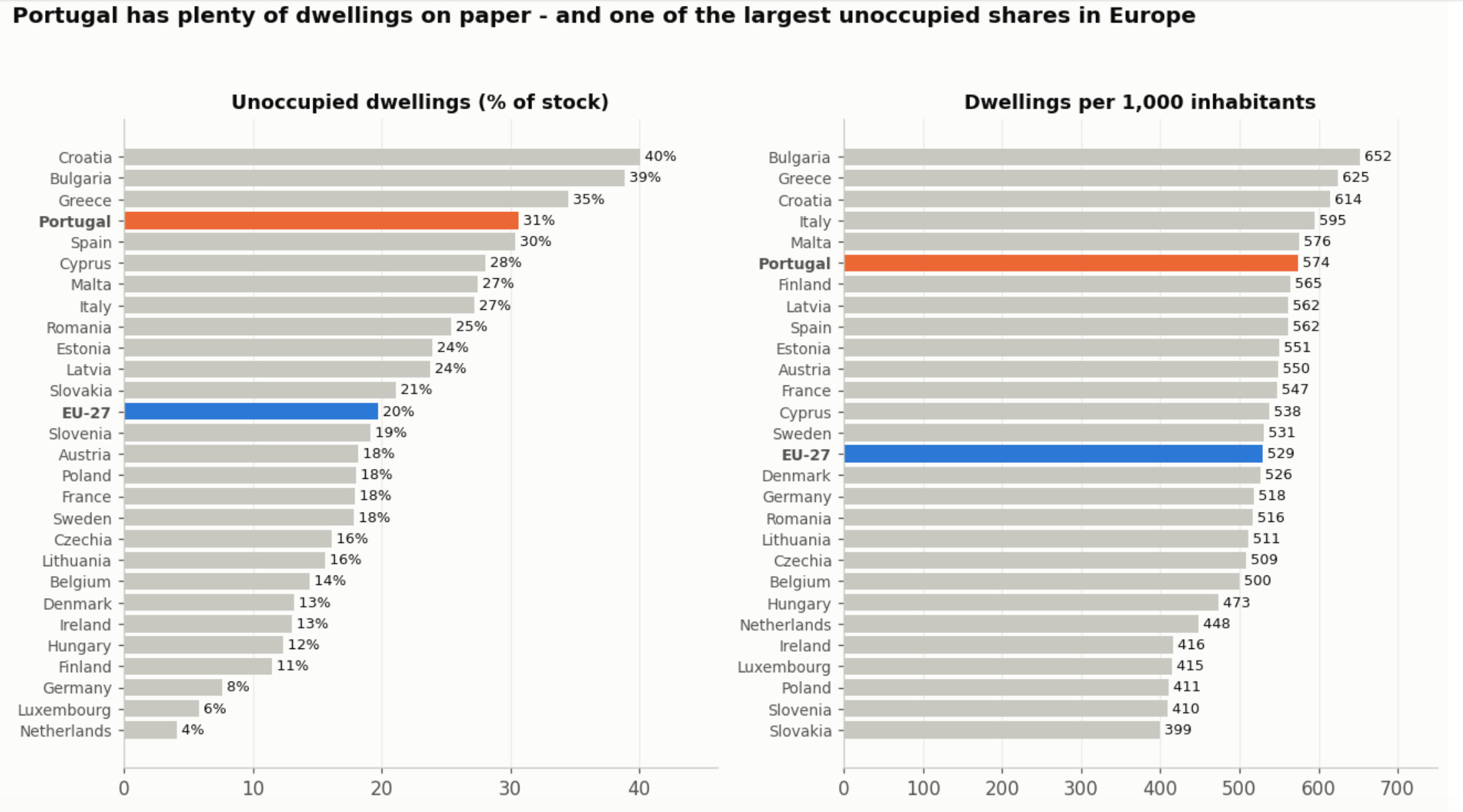
This is a luxury Portugal can’t afford. We’ve largely stopped building, more people live here every year, and we still leave more than 700,000 homes empty.
It’s a policy problem created by weak politicians
None of this is a mystery. Once you look at the data, the problem is almost obvious, and politicians failed to prepare the country for it. It will only get worse if we don’t address:
More construction.
Spreading the pressure, so people aren’t all piling into the already full housing markets of Lisbon, Porto and the Algarve.
Solving vacancy and inheritance deadlocks, and doing it fast.
Weighing the real cost and benefit of NHR. The regime was partly amended in 2023, and the data backs that change.
More public housing (another myth I’ll tackle in Part 2).
Better public transportation (also in Part 2).
The current government is trying to move things with a new rent law. As drafted, it allows eviction after two months of arrears instead of three, raises the advance rent landlords can ask for to three months, removes the cap on deposits, ends the 2% limit on rent increases between contracts, and lets landlords refuse renewal with no minimum period. The bet is that a more flexible market brings more homes to rent. That doesn’t make a lot of sense after seeing this data. The group the data shows is most squeezed is market-rent tenants, and this law makes their position more fragile right now, in exchange for a supply response that might take decades to arrive.
On the rest, my scorecard is mixed:
Public housing: this is where the data sides most with the protesters. Social rental housing is 1.1% of dwellings in Portugal, against an EU average of 8%. At €150,000 per home, 3% financing and public land, a cost-rent home in Lisbon breaks even at about €10.9/m² a month, 35% below the city’s median new rent. It can almost pay for itself exactly where it’s needed most. Remember the €1.74 billion NHR cost in 2024? That’s roughly 11,600 of those homes. In one year.
Vacant homes: worth chasing, in the right places. The 100,000-plus recoverable homes in pressure municipalities are real.
Limiting investment funds: I can’t back it or reject it, because the data doesn’t exist. Before we legislate, we need to measure.
Nobody planned Portugal’s housing crisis, but plenty of decisions built it, and decisions can be unmade. The least we should ask is that the next ones start by looking at the data.
So, are the tents right?
Yes, although there’s no single villain. The main problem is a country that is dealing with its own structural lack of planning almost stopped building homes after the crisis, kept on focusing on only 3 regions (Porto, Lisboa and Algarve), and then tried to fix it by giving buyers more money.
To understand why the anger of the protesters looks the way it does, start with one fact: Portugal is a country of owners. 71% of us own our home, many without a mortgage. For that majority, the boom has been invisible or even good news: the flat they bought in 2005 is now worth three times as much.
The squeeze lands on everyone outside that club.
Sources and notes
That’s Part 1 of the myth-busting done! Part 2 is already out and covers the other ingredients in the mix: transportation, public housing, and Airbnb. Read Part 2 here.
Every number comes from my notebook, which pulls INE, Banco de Portugal, Eurostat, ECB, OECD and World Bank data live. Prices run to Q2 2026, population and income to end-2025. The municipal analysis shows associations, not causes. Policy facts (NHR cost, golden visa, the IMT surcharge) come from official documents and press reports and are flagged as such in the notebook.
On the protests and the rental law:
Centenas acampam no centro de Lisboa contra a crise da habitação, Lisboa Para Pessoas
Acampamento pelo direito à habitação termina no Rossio após intervenção da PSP, Sol
Tents fill Lisbon square as protesters highlight Portugal’s housing crisis, Euronews
Arrendamento: revisão da lei prevê fim de limite às rendas e agiliza despejos, DECO PROteste
Arrendamento urbano passou no parlamento, Lexpoint
Note: As with most economic analysis, we can’t run controlled experiments to prove what causes what. What we can do is use correlations and historical data to form hypotheses. Everything in this piece is, I believe, a strong hypothesis that helps explain why house prices are where they are today, but not a proof.
Fascinating read! I’m surprised you didn’t use data from devolutos.com regarding abandoned buildings in Lisbon (separate from vacant dwellings). It’s a pretty good example of participatory GIS, and I think it’s been more than a year since it launched. Last I checked they estimate more than 10% of Lisbon has abandoned apartments that could house an additional 20,000 residents. Looking forward to the next part, I remember checking https://insideairbnb.com/lisbon/ and being shocked at the number of listings the top 10-15 members have, and it being split between Portuguese citizens and companies.
Great piece, and the closest thing to a full picture I’ve seen so far.
One angle I’d add: Portugal is also one of the oldest countries in Europe (188.8 seniors per 100 young people in 2025). If young people can’t afford a home, they don’t have kids or they emigrate, and in 15 years the same owners whose homes tripled in value will need nurses and carers who either weren’t born, left, or can’t afford to live near them. Housing isn’t just a youth problem.